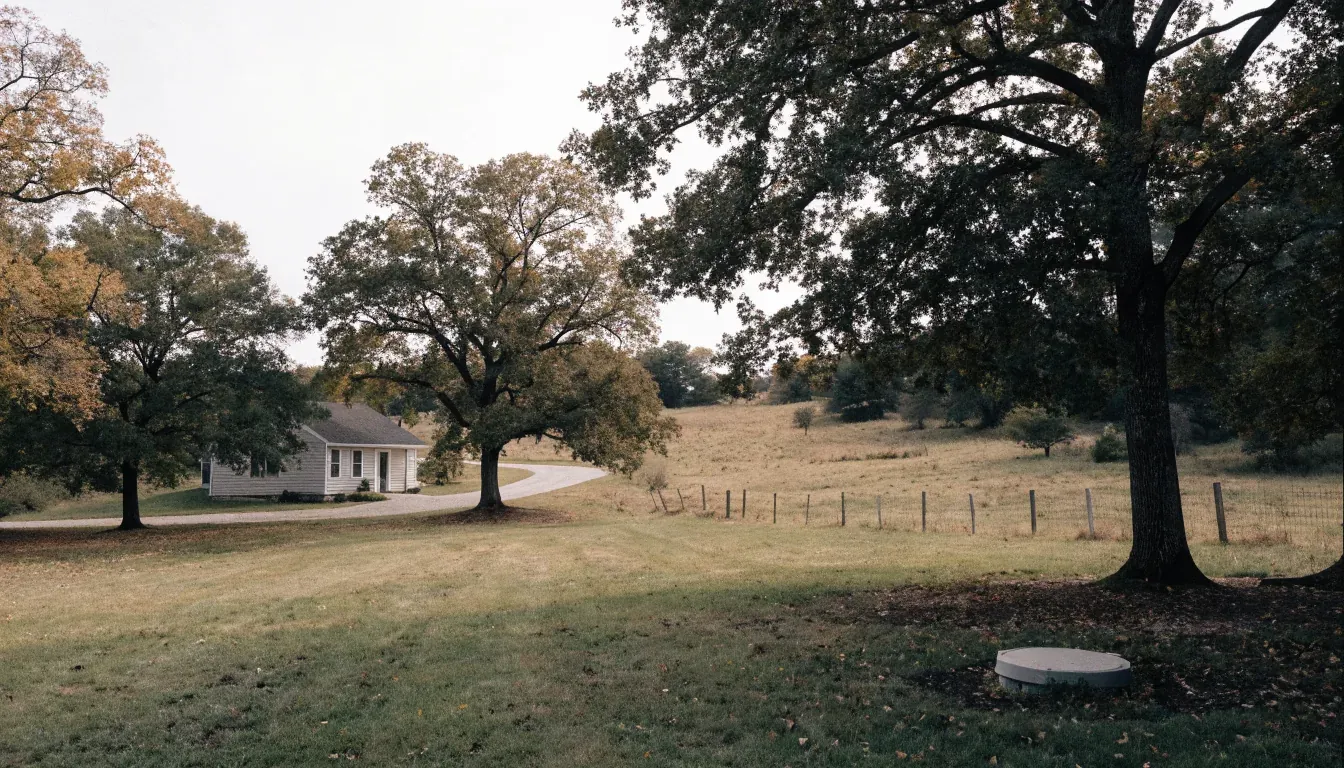

Septic installation and replacement in St. Charles County, Missouri
St. Charles County is one of the strictest septic jurisdictions in Missouri, and the first surprise is who runs it: not the health department, but the Division of Building and Code Enforcement. The county adopted its own private sewage disposal code, and that code goes well past the state minimum in ways that decide whether a project is possible at all. A new system needs at least three acres. New lagoons are not allowed. If a public sewer runs within two hundred feet of your nearest property line, you connect to it rather than installing a system. And selling a house on septic triggers a mandatory inspection before the transfer.
Who issues a septic permit in St. Charles County, MO?
The St. Charles County Division of Building and Code Enforcement. That is the office to call before anything else, because in Missouri the permitting authority is not the same kind of agency in every county, and assuming it is the health department wastes a week in the counties where it is not.
Phone (636) 949-7345. Their page: St. Charles County Division of Building and Code Enforcement.
Source: Missouri Department of Health and Senior Services, onsite wastewater construction permit authority lookup for St. Charles County, read 2026-09-12. Fees, forms and requirements change, and this county is the only current source for its own.
What does St. Charles County require beyond the state standard?
- A minimum of three acres is required for the installation of a new onsite wastewater treatment system, countywide. This is the most common reason a St. Charles County lot cannot take a new system at all. Source: St. Charles County, Onsite Wastewater Treatment Systems FAQ, read 2026-08-26.
- The county does not allow the installation of new lagoons, and it does not allow the surfacing of sewage regardless of property ownership. Source: St. Charles County, Onsite Wastewater Treatment Systems FAQ, read 2026-08-26.
- The county sets its own setbacks in place of parts of the state table: for new construction a sewage tank must be one hundred feet from any private water supply, and both sewage tanks and absorption fields must be thirty feet from any property line, against the state table’s ten feet. Source: St. Charles County, 2021 Private Sewage Disposal Code amendments to Section 802, read 2026-08-26.
- A public sewer is considered available when the nearest property line is within two hundred feet of it, and where it is available you connect rather than installing a system. Source: St. Charles County, Private Sewage Disposal Code Section 101.2 as amended, read 2026-08-26.
- Before ownership of a property served by a private sewage system transfers, the seller must have that system inspected for compliance with the county code, by a third-party inspector licensed by St. Charles County. Source: St. Charles County Ordinances, Section 500.310(A), read 2026-08-26.
- Owners must show evidence of ongoing maintenance: conventional systems at a minimum of every five years, and alternative systems yearly. Source: St. Charles County, 2021 Private Sewage Disposal Code amendments, read 2026-08-26.
- The county struck the percolation test sections from the code it adopted, so design here runs off soil morphology rather than percolation rates. Source: St. Charles County, 2021 Private Sewage Disposal Code amendments, Sections 404.2.1 to 404.2.4 deleted, read 2026-08-26.
Missouri lets a county adopt standards more restrictive than the state's, so a requirement here is not evidence of the same requirement one county over.
Source: Missouri Department of Health and Senior Services, Onsite Wastewater Treatment, read 2026-09-12.
What is the ground like in St. Charles County?
St. Charles County is glacial till country with big-river alluvium along its edges, not Ozark karst. The whole county sits north of the Missouri River, which forms its southern boundary, with the Mississippi to the northeast. The practical consequence is that percolation rate rather than depth to bedrock is usually the governing constraint, and the bottomland soils near both rivers bring the seasonal high water table into the design.
That matters because the soil decides the system. A standard system needs at least one foot between the trench bottom and the limiting layer or seasonal high water table, rising to four feet to groundwater or bedrock in highly permeable soils and in cherty clay soils in areas of severe geological limitations, and a percolation rate slower than sixty minutes per inch pulls a registered engineer onto the design.
The soil evaluation is what settles it for your particular lot.
Source: 19 CSR 20-3.060(5)(A)2., Missouri Code of State Regulations, read 2026-09-12.
Which towns does this cover?
St. Charles County has St. Charles as its county seat. Places served include O'Fallon, St. Peters, Wentzville, Lake Saint Louis, Cottleville, Dardenne Prairie, Weldon Spring, New Melle, Flint Hill, Foristell, Augusta, Portage Des Sioux. Anywhere in the county not on a public sewer is on a system this page applies to.
Who is allowed to do the work here?
An installer registered with the Missouri Department of Health and Senior Services. That is a state requirement rather than a county one. The statute carrying it also carries a large-lot exclusion for some single-family lots of three acres or more, on strict conditions, and a county regulating under its own ordinance can require its own permit and its own registration regardless, which is what the collar counties around St. Louis do. Some counties add their own licensing on top of the state registration, which is one more reason to ask the permitting authority what they require before you sign anything.
Who is allowed to do the work covers what registration means here.
Source: Section 701.031, Revised Statutes of Missouri, read 2026-09-12.
What we could not confirm for this county
The county publishes a building permit fee schedule that includes onsite wastewater lines, but fee amounts change and the schedule is the only current source, so no figure is repeated here. Requirements inside incorporated cities may differ from the unincorporated county, and the Division contracts with some cities and not others. Confirm both with the Division before relying on either.
Get a free quote from a septic contractor in St. Charles County
Tell us the county and the job. No email needed.
A marketing service, not a licensed contractor. Septic work is performed by independent local contractors.
Need the job done, not just the rule explained
Your request goes straight to an independent local septic contractor serving your Missouri county, usually within about an hour during the day, not a national lead list.
Tell us the county and the jobLast reviewed 2026-09-12.