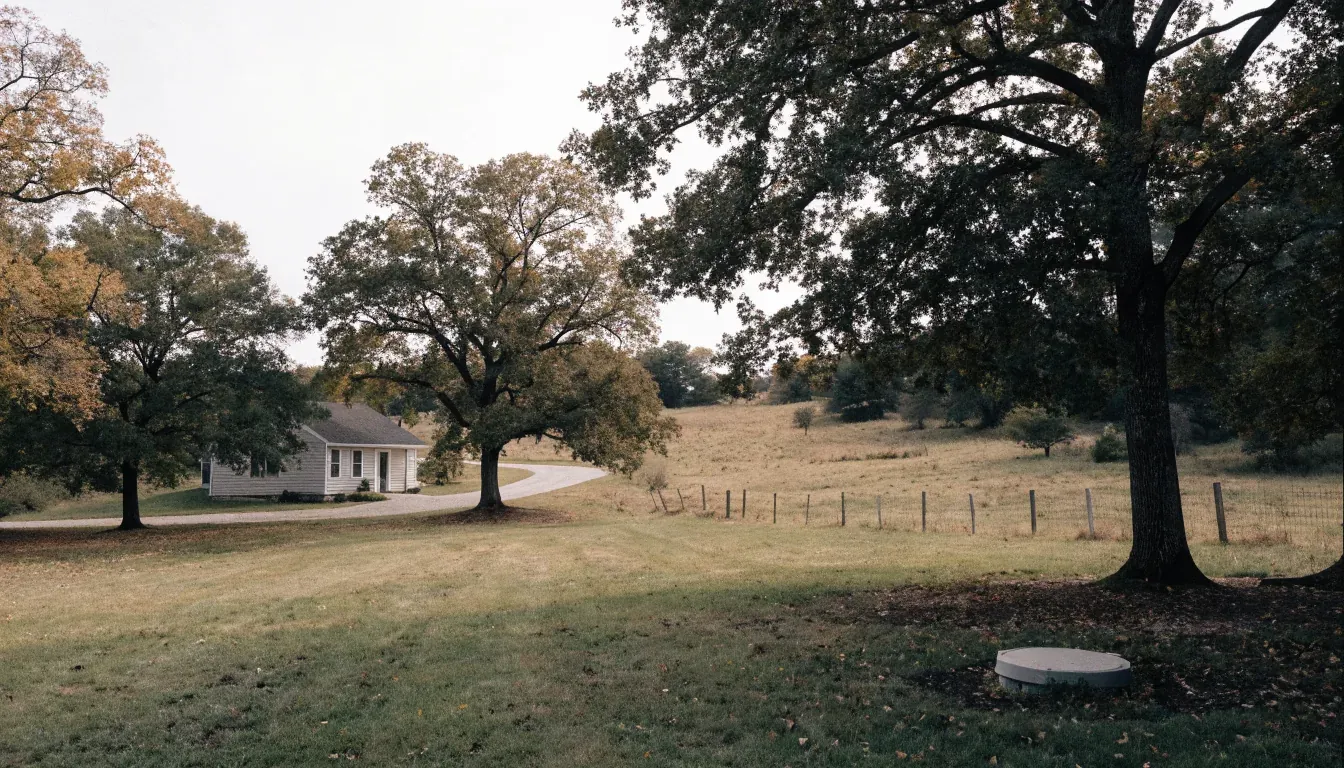

Soil evaluation and perc tests in Missouri
The soil decides the system. Before a Missouri onsite system is designed, the site has to be evaluated, and a profile pit is required for every new installation so the soil can be read directly rather than guessed at. What that evaluation finds sets everything downstream: the size of the field, whether a conventional trench system is possible at all, whether an engineer has to draft and sign the design, and in the hardest ground whether an absorption system can be used on the property at any price.
Source: 19 CSR 20-3.060(2)(A), Missouri Code of State Regulations, read 2026-09-12.
What is the difference between a perc test and a soil evaluation?
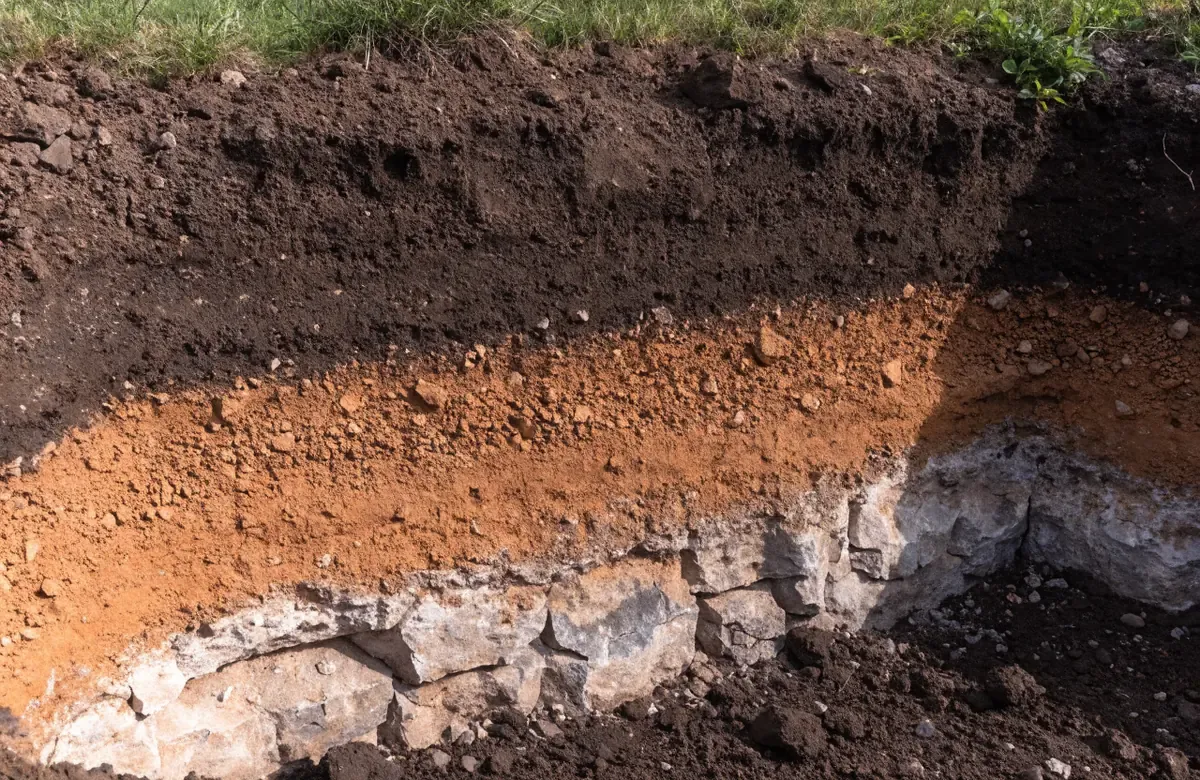
They are two ways of answering the same question. A percolation test measures how fast water actually drains out of a hole in the ground. A soil morphology evaluation reads the soil profile itself, describing the horizons, the texture, the structure and the depth to any limiting layer, and infers the loading rate from what the soil is.
The practical difference matters: where a soil morphology evaluation is used, no percolation test is required, although the administrative authority may still ask for one. Morphology is the more informative of the two, because it tells you why the ground behaves the way it does rather than only that it does.
Source: 19 CSR 20-3.060(2)(D)1. and 2., Missouri Code of State Regulations, read 2026-09-12.
There is now a date on this. Senate Bill 914 amended the statute with effect from August 28, 2026, and the subdivision that lets an administrative authority accept a percolation test where a soil morphology evaluation cannot reasonably be obtained is void after December 31, 2026. The same subdivision carries the continuing-education registration for people qualified to run percolation tests, and it ends on the same date. The construction rule itself still describes percolation testing and has not been amended, so what is ending is the statutory instruction behind it. If your project is being designed off a percolation test, ask your permitting authority what it will accept after the end of 2026 before you pay for one.
Source: Section 701.040(5), Revised Statutes of Missouri, as amended by Senate Bill 914, effective August 28, 2026, read 2026-09-12.
Who is allowed to perform each one?
Percolation tests are to be conducted by an engineer, a sanitarian, a registered geologist, a soil scientist, or a person trained and certified by the department. The soil morphology evaluation has a narrower list: a soil scientist, unless an engineer, registered geologist or sanitarian has had special training and field experience in determining the required soil characteristics.
The state points property owners at its own Find a Professional lookup for registered onsite soil evaluators. Treat it as a starting point rather than a complete roster of everyone qualified near you, and reach the Onsite Wastewater Treatment Program on (573) 751-6095 if the lookup does not turn somebody up.
Source: Missouri Department of Health and Senior Services, Onsite Wastewater Treatment frequently asked questions, read 2026-09-12.
How is a Missouri perc test actually run?
The method is set out in the rule rather than left to the tester. At least four test holes are required: three around the edge of the proposed absorption site and one in the middle. The holes are six to eight inches across with vertical side walls, dug to the depth of the proposed system bottom.
Then comes the part people are surprised by, which is the waiting. The hole is filled with clear water to at least twelve inches over the soil bottom and held there for no less than four hours, then left to swell for at least twenty-four hours before the measured readings begin. A test run without that presoak is not the test the rule describes, and a wet-season shortcut can flatter ground that will not perform in August.
Source: 19 CSR 20-3.060(2)(D) and (5)(A)1., Missouri Code of State Regulations, read 2026-09-12.
What percolation rate forces an engineer onto the job?
Slower than sixty minutes per inch. At that point the design has to be drafted and signed by a registered engineer, unless site suitability and system sizing have been established by a soil evaluation under section (7) of the rule. This is the single most common reason a routine-looking Missouri septic project acquires a second professional and a longer timeline.
There is a harder line beyond it. Absorption trenches should not be built in soils slower than sixty minutes per inch, and in no case may they be built in soils slower than one hundred twenty minutes per inch. Past that, a trench field is off the table and the design moves to something else entirely, which is where lagoons and engineered alternatives come in.
Source: 19 CSR 20-3.060(2)(D) and (5)(A)1., Missouri Code of State Regulations, read 2026-09-12.
How much separation is needed under the trench?
At least one foot between the bottom of the absorption trench and the limiting layer or the seasonal high water table for a standard system. In highly permeable soils, and in cherty clay soils in areas of severe geological limitations, that requirement rises to four feet to groundwater or bedrock.
That four-foot case is not an edge case in Missouri. Cherty clay over shallow limestone is ordinary Ozark ground, and it is exactly the profile where a lot that looks perfectly buildable turns out to need a mound, a drip field or an engineered design. It is also why the same house plan costs differently in Christian County than it does on the northern till plains.
Source: 19 CSR 20-3.060(5)(A)2., Missouri Code of State Regulations, read 2026-09-12.
Why does this happen before you buy the land, not after?
Because the evaluation can come back saying no. A lot with slow enough soil, shallow enough bedrock or a high enough water table can be unsuitable for a conventional system, and the alternatives cost real money. A soil evaluation ordered before closing is the cheapest version of that discovery. Ordered after, it is a renegotiation you no longer have leverage in.
Ask for the report to identify a replacement field area as well as the primary one. Fields do not last forever, and a lot with nowhere to put the second one is a different asset from a lot that has room.
What to ask for in the report
- Depth to bedrock and to any restrictive layer, stated as a measurement.
- Seasonal high water table evidence, since that is what the one-foot and four-foot separations are measured against.
- The loading rate the design will be sized on, and whether it came from morphology or percolation.
- Whether the result triggers an engineered design.
- A located primary field area and a located replacement area.
Then take that report to the permit application, which is where it does its work.
Get a free quote for a soil evaluation or septic design
Tell us the county and the job. No email needed.
A marketing service, not a licensed contractor. Septic work is performed by independent local contractors.
Need the job done, not just the rule explained
Your request goes straight to an independent local septic contractor serving your Missouri county, usually within about an hour during the day, not a national lead list.
Tell us the county and the jobLast reviewed 2026-09-12.